
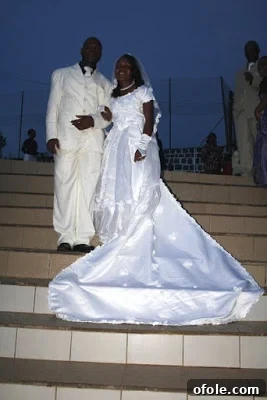
Hello, cherished readers. Today marks a truly special occasion for me – my sixth wedding anniversary! To honor this milestone, I want to share a deeply personal and candid story with you: my wedding night experience. This narrative was first published on my dear ‘sister,’ Commy Mussa’s blog, SISTERS SPEAK 237. Prepare yourselves, because I am about to recount everything that unfolded immediately after the joyous scene captured in this very photo:
The air was thick with anticipation as the moment everyone in attendance had been eagerly awaiting finally arrived. Our pastor, his voice brimming with heartfelt enthusiasm and a wide smile, declared:
The hotel’s interior immediately impressed us. Its upscale decor was a refreshing feast for the eyes, a stark contrast to the bustle of the wedding day. Various exquisite works of art adorned the walls, lending an air of sophistication and tranquility to our surroundings. It truly was a pleasant sight, setting a romantic tone for our arrival.
At the welcome desk, a warm greeting awaited us from a brown-skinned receptionist. As my husband negotiated for our room, my thoughts were entirely consumed by a single, powerful three-letter word – love, or perhaps, the physical expression of it – the very force that seemingly makes the world go round. My heart pounded with eager anticipation.
When we finally entered our chosen sanctuary, the room did not disappoint; in fact, it exceeded my already high expectations. The deep red sheets on the bed immediately caught my eye, speaking a silent, passionate language of love and romance. It was a calm, convenient, and perfectly designed cubicle, exuding an aura of intimacy and comfort. This felt like the ideal setting, the perfect stage for the romantic adventure I had been dreaming of.
The following afternoon, when some of our family members saw us, dressed in matching outfits that symbolized our newly wedded status, they erupted into joyful ululations. Their celebratory cries, filled with happiness and tradition, were meant to acknowledge the consummation of our marriage. Little did they know, however, that despite all appearances, the marriage remained unconsummated. The cheers and excitement only served to deepen my inner turmoil, highlighting the stark contrast between public perception and our private reality.
I was utterly and completely disappointed in myself. A profound sense of failure washed over me, prompting a cascade of self-doubt. What was I missing? How could I truly embody the “sweet in bed” advice I had received? We continued our attempts for the entire following week, each effort yielding the same disheartening results. Then, an added layer of challenge presented itself: Mr. N had to depart for work. As a Marine Electrical Engineer, his responsibilities took him to Equatorial Guinea, meaning he would be away for two long, agonizing months.
With his departure, the level of disappointment in myself escalated dramatically. It morphed into a heavy blend of confusion, uncertainty, and gnawing doubt. I meticulously examined my own body, specifically my “lady parts,” trying to understand what the obstacle could be. My conclusion, based on my limited understanding, was disheartening: there seemed to be no conceivable way that “a thing that big” was ever going to go through and stay there comfortably. This physical apprehension was compounded by a growing sense of vulnerability and inadequacy.
In my despair and confusion, irrational thoughts began to surface. I even considered the possibility that I had been bewitched by some ill-meaning family member, a common belief in certain cultural contexts. These distressing thoughts ran through my mind like relentless waves in a torrent, each one adding to my overwhelming sense of helplessness and fear. The lack of explanation, coupled with the profound pressure of marital expectations, drove me to contemplate even the most superstitious of possibilities.
The more than a week of concerted efforts to “eat the fruit of marital goodness” had felt like nothing short of a wild-goose chase. Each attempt was met with the same frustrating outcome, the only tangible result being a persistent soreness and an increasingly heavy heart. The physical discomfort was a constant reminder of our struggles, a physical manifestation of my emotional distress.
I couldn’t help but wonder why something so widely celebrated and portrayed as wonderful in novels, movies, and by friends had turned out to be so excruciatingly gruesome for me. These informal sources had, in essence, been my primary educators on sex. My formal education on the subject was virtually non-existent. When I first began menstruating, my mother had issued a stern, singular warning: “If a boy touches you now, you will get pregnant.” That was, quite literally, the extent of her counsel on sex. My father? He lived his life as though the topic of sex simply did not exist. It was as if he himself hadn’t been a product of it. He never approached the subject, not even in jest, leaving a significant void in my understanding.
My biology teacher, under the academic obligation to cover the topic of ‘reproduction,’ was the only person who managed to teach about sexual intercourse in a school setting. The initial reaction from the class was a chorus of giggles, jeers, and uncomfortable shuffling, enough to make even the most resolute teacher quickly digress. Yet, amidst the boos and general awkwardness, she pressed on, demonstrating remarkable composure and dedication. For the very first time, I heard words like ‘erection,’ ‘penis,’ ‘vagina,’ and other terms from the lexicon of human sexuality pronounced by real lips, openly and without euphemism. It was undoubtedly a challenging experience for her, navigating the raw curiosity and sometimes inappropriate reactions of a classroom full of teenagers, but she remarkably pulled through, delivering the information that was, in hindsight, desperately needed.
My other significant form of sexual education came from the church, where the prevailing principle was that I must remain untouched until my wedding night. It was consistently preached that the greatest gift a bride could ever bestow upon her husband was her virginity. Anytime the topic of sex was broached in a church youth gathering, this same phraseology was meticulously rehashed: “keep your primary or secondary virginity as a gift for your husband.” The emphasis was almost exclusively on preserving this ‘gift,’ with little to no practical guidance on what to actually do with it, or how to navigate the physical and emotional realities of marital intimacy once that gift was intended to be ‘unwrapped.’
So, on my wedding night, fueled by these teachings and my own innocence, I entered the hotel room with the confidence of a queen, my bridal tiara still adorning my head, as if I were about to receive a “Bride of the Year” trophy for my diligent preservation of this sacred gift. But the very gift I had so strictly kept, as instructed by every authority figure and institution, stubbornly refused to be unraveled. Our various, increasingly desperate attempts at penetration failed, each one ending in frustration and confusion. It was, unequivocally, a night void of coitus, a profound disappointment that left me feeling bewildered and inadequate.
It took another two long and emotionally trying months before our breakthrough finally arrived. The moment was a complex tapestry of pleasure intertwined with a lingering, familiar pain, a testament to the journey we had endured. There was immense relief that the perceived “spell” was finally broken, that our physical union had at last been achieved. Yet, even in that moment of success, it did not stop me from wondering if my experience was somehow anomalous, if I was an unusual case in the vast landscape of marital beginnings.
Several months later, a casual conversation with a close friend brought a surprising and comforting revelation. She confided in me, sharing a remarkably similar experience. She and her then-fiancé, much like us, had repeatedly tried to “unlock the gate to her womanhood” but found themselves hitting a frustrating wall. She recounted her fear, her profound sense of being physically incomplete, to the point where she genuinely believed she might need surgery to create a “hole” for “it.” When I, in turn, shared my own struggles and eventual breakthrough, we burst into a shared, cathartic laughter – a blend of relief, understanding, and perhaps, a touch of residual absurdity. It was a powerful moment of connection, realizing I was not alone in this deeply personal, yet surprisingly common, struggle.
I understand, and truly appreciate, that many parents, pastors, and respected role models within society often refrain from engaging in explicit conversations with young people about sex. Their reluctance often stems from a genuine desire to avoid stirring “the wrong emotions” or to protect innocence. However, what is frequently overlooked is the crucial necessity of engaging in age-appropriate discussions. The information you would sensitively share with a curious 3-year-old about their body is, and should be, vastly different from what you would discuss with a rapidly changing 13-year-old, or indeed, a fully matured 30-year-old navigating the complexities of adult relationships.
A 3-year-old, for instance, might simply need to learn the correct anatomical term for what she innocently calls her “pee-pee,” understanding that it is actually referred to as a vagina. A 13-year-old, on the cusp of womanhood, needs to be informed that she is entering the transformative period of puberty, and that certain parts of her body may become more sensitive to touch than others, accompanied by a myriad of other physical and emotional changes. But a 30-year-old, whether single, dating, or newly married, requires a far more comprehensive and nuanced understanding. She needs to grasp the intricacies of sexual health, consent, pleasure, intimacy, communication in relationships, and the vast emotional landscape that accompanies sexual experiences. The absence of this progressive education leaves young adults ill-equipped for one of life’s most fundamental aspects.
Reflecting on my own journey, as a young Christian girl, I deeply wish I had been taught, not with fear, but with grace, that sex is a truly wonderful and sacred gift created by God within the bounds of marriage. I wish I had been given more detailed, honest, and comprehensive insights into the nature of sexuality and the vast intricacies of the human body, particularly my own. Had I possessed this foundational knowledge, I believe I would not have endured those agonizing weeks feeling as though I was suffering from some kind of inexplicable aberration, a unique flaw that set me apart. This basic education is a cornerstone for positive body image and healthy intimate relationships.
The absence of knowledge, particularly concerning such a fundamental aspect of human life, is an undeniable invitation to fear. When fear takes root, it insidiously prevents women from fully embracing and having positive, fulfilling sexual experiences. It creates barriers to intimacy and self-acceptance. Now that I possess a deeper understanding and perspective, armed with the wisdom gained from my own struggles, I am resolutely committed to educating my own daughters. My fervent hope is that by providing them with open, honest, and age-appropriate discussions about their bodies, sexuality, and relationships, the painful and confusing parts of my history will not repeat themselves in their lives. This cycle of silence must be broken, replaced by empowering dialogue.